
Tracking and Managing Refractive Power Changes in Children as They Grow Up
A child’s first pair of spectacles is rarely the last. Many parents are surprised when, a year later, the teacher says their child is squinting at the board, or the headaches come back. This does not always mean something has gone wrong. Growing eyes keep changing, and the refractive power needed to keep vision sharp changes with them. Knowing how and why this happens helps families stay a step ahead.
Why Does a Child’s Spectacle Power Keep Changing?
A baby is usually born slightly farsighted. As the child grows, the eyeball lengthens, and the focusing system adjusts so that light settles neatly on the retina. This process is called emmetropisation.
In some children it works out perfectly. In others, the eye keeps lengthening past the ideal point, which leads to myopia. Others stay hyperopic, or their astigmatism shifts as the shape of the cornea changes. Growth spurts in the school years often bring changes in spectacle power, sometimes quite quickly.
Which Refractive Errors Are Most Likely to Change?
All three common errors can change, but not in the same way.
- Myopia (nearsightedness) tends to increase through childhood and the teenage years. In some young people, it continues into the early twenties.
- Hyperopia (farsightedness) often reduces gradually as the eye grows, though not in every child.
- Astigmatism can stay stable, increase, or ease, so it needs rechecking even when the sphere power looks unchanged.
Signs That a Child’s Power May Have Changed
Young children seldom say that their vision has worsened. They simply adapt. Look out for:
- Sitting very close to the television or holding books and phones near the face
- Squinting, or frequently rubbing the eyes
- Headaches or tired eyes after reading or homework
- Tilting the head or closing one eye to see better
- Losing interest in reading, or a sudden dip in school performance
- Difficulty copying from the blackboard
Any of these is reason enough for an early review, even if the last check-up was only a few months ago.
How Often Should a Child’s Eyes Be Checked?
For most children wearing spectacles, an eye check-up for children every six to twelve months is a sensible routine. A child whose myopia is moving quickly may need to be seen more often. A child with a new complaint should not wait for the next scheduled visit.
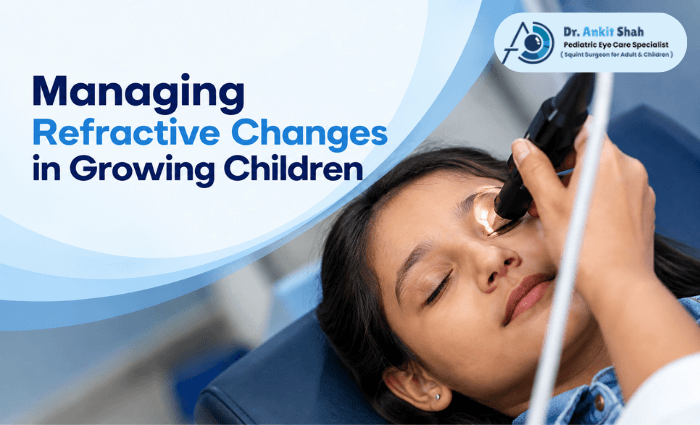
Accuracy matters too. Young eyes have strong focusing muscles that can hide the true power. This is why a pediatric ophthalmologist often uses eye drops to relax the focusing system before measuring, which is called cycloplegic refraction. It is a routine test and gives a far more reliable reading than a quick check without drops.
What Does Tracking Actually Involve?
Tracking is more than reading out a new prescription. A proper review usually looks at vision in each eye, the refraction, eye alignment, and overall eye health. Comparing today’s numbers with earlier ones shows whether the change is slow and steady or faster than expected.
So keep every old prescription. A simple folder or a photo album on your phone is enough. The pattern across several years often tells the doctor more than any single visit. Families looking for a pediatric ophthalmologist can bring these records to the consultation, which makes the comparison much easier.
Managing Changes as the Years Go By
The first step is simple: update the spectacles when the power changes, and make sure the child actually wears them. Outdated lenses or spectacles kept in the school bag do little good.
Where myopia progression is faster than expected, doctors may recommend additional measures to slow it down. These are chosen after a full assessment and not by a one-size-fits-all rule. You can read more about how it advances and why regular follow-up matters in our article on how myopia progresses in growing children and why early monitoring matters.
Daily habits also help:
- Encourage time outdoors every day, as natural light seems to be protective for young eyes.
- Keep a comfortable reading distance, and take short breaks from close work and screens.
- Make sure study areas are well lit.
- Follow the schedule of follow-up visits, even when the child says everything looks fine.
A Few Common Myths
“Spectacles make the eyes weaker.” They do not. Spectacles simply let the child see clearly. The power changes because the eye is growing.
“Power stops changing after ten years.” Not necessarily. Many children continue to change through their teens, and the numbers usually settle only in the late teens or early twenties.
“If my child sees well, there is no need for a check-up.” A child may manage with one stronger eye and not complain. Regular review catches problems that casual observation misses.
What Parents Should Remember
Changes in power are a normal part of growing up, and with regular checks they are easy to manage. The aim is a clear picture of how your child’s eyes are developing, so that spectacles stay accurate and any faster change is noticed early.
If your child’s last check-up was more than a year ago, or you have noticed any of the signs above, it is a good time to book a review. Schedule a comprehensive eye evaluation with Dr. Ankit Shah, and get clear, personalised guidance for your child’s growing eyes