
How Myopia Progresses in Growing Children and Why Early Monitoring Matters
Myopia, which is otherwise called nearsightedness, is becoming more and more common among children. A child suffering from myopia is normally able to see nearby objects, although he or she might experience trouble viewing distant objects, like the board in class, television, and signboards on the road.
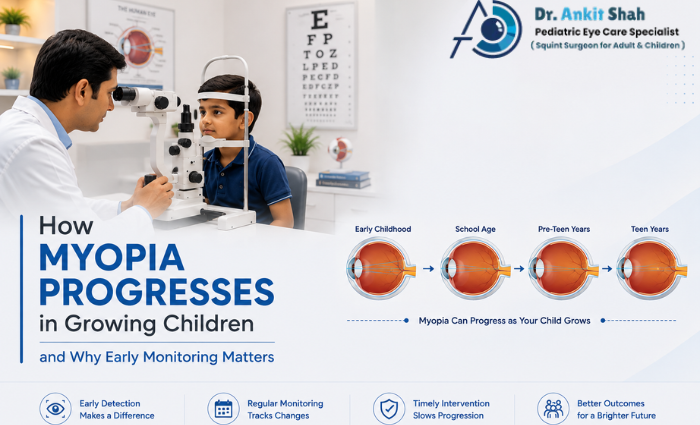
Not all cases of myopia among children stay the same, since as the eye grows, the amount of nearsightedness may change. Myopia progression in children should be known about in order to detect any change and to consult an eye doctor.
What Happens When Myopia Progresses?
Myopia occurs as a result of the elongation of the eye beyond its normal size or due to the ability of the optical elements of the eye to focus light rays in front of the retina instead of on it. Since the eye undergoes development during childhood, any alteration in its structure will result in the need to increase the prescription for glasses.
At the beginning of the condition in a child, there may only be mild myopia. But with time, the prescription may become more powerful. The rate at which this occurs varies with different children, depending on things like genetics, age of diagnosis, environmental factors, and outdoor time.
It is for this reason that childhood myopia should not be looked at as just another glasses prescription.
Why Can Myopia Increase During Childhood?
Myopia progression is related to some genetic and environmental variables. Children whose parents suffer from myopia have a greater probability of suffering from the disease.
Environmental and lifestyle variables could also have something to do with this problem. Scientific studies have indicated that there is a relationship between spending more time outside and less chances of developing myopia, while the link between near work and myopia is more complicated than believing that myopia results just from reading.
It could be part of the strategy to encourage kids to spend time outside, adopt good eye habits and follow adequate routines with screens and near work.
Why Is Early Monitoring Important?
Not only does it matter whether a child wears glasses, but the question is also whether their prescription changes over time.
Eye check-ups make it possible for an ophthalmologist to track visual acuity and refraction changes and, when necessary, evaluate other factors related to myopia progression. According to the American Academy of Ophthalmology, routine screenings and selective evaluation of children prone to myopia progression are essential as the prevalence of myopia is growing among children.
- It is necessary to observe whether there are such symptoms as:
- squinting to view distant objects,
- sitting too close to the TV,
- having trouble seeing the board in class,
- holding books or other items very close to the face,
- complaints about blurring of distant vision,
- increasing glasses prescription from check-up to check-up.
Sometimes children do not complain about their poor eyesight at all, especially when it comes to one eye or they just got used to it gradually.
What Does Myopia Control in Children Involve?
Myopia control in children is associated with the management of progression of myopia instead of correction of vision blurring.
This will depend on several factors including the age, prescription, rate of progression, medical and family history, eye health, and others. Based on the clinical examination, an ophthalmologist will recommend some approaches that will be able to stop the progression of myopia.
Therefore, follow-up is very useful since comparison of results will allow an ophthalmologist to see whether the development of myopia is progressing or not. The management of this condition can be modified depending on this observation.
Parents should never start any myopia control treatment by themselves. Children’s eyes continue their development, therefore the choice of the treatment should be done after the appropriate eye examination.
When Should Parents Consider a Pediatric Eye Evaluation?
In cases where a child has been exhibiting problems with long-distance vision, a change in prescription in glasses or has a history of myopia within the family, an eye test may help in providing some information on the vision and development of the eye of the child.
There are many pediatric ophthalmologists in Ahmedabad who will be able to help parents assess the condition of their children’s vision by carrying out vision tests that are appropriate for their age group.
Dr. Ankit Shah is a Pediatric Ophthalmologist & Squint Correction Specialist who offers pediatric eye care, vision screening, refractive assessment, and management and control of myopia.
The Takeaway for Parents
Myopia can change as a child’s eyes grow, which is why monitoring is an important part of childhood eye care. Glasses can provide clear vision, but regular assessments can also help identify whether the prescription is changing and whether further management should be considered.
Early attention does not necessarily mean that every child needs treatment. It means having the child’s vision assessed at the appropriate time so that any changes can be understood and managed responsibly.
Book an Appointment with Dr. Ankit Shah
If you have observed any changes in your kid’s far vision or are worried regarding the increasing strength of your kid’s glasses, you may want to Book an appointment for a pediatric eye exam from Dr. Ankit Shah. An assessment at the right time can help you know more about your kid’s present vision and possible solutions.