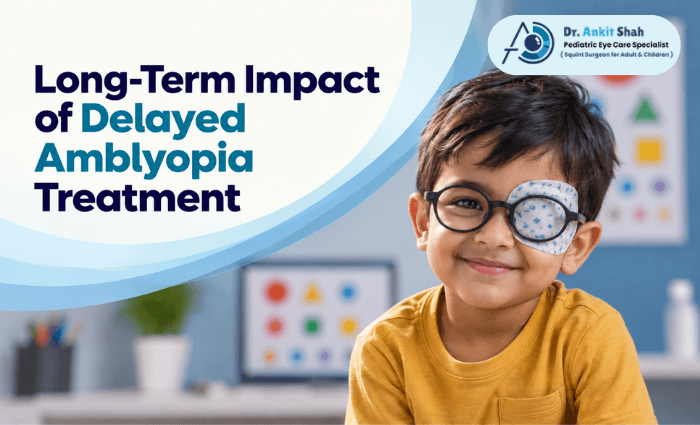

The Long-Term Cost of Delaying Treatment for a Lazy Eye in Young Children Squint Explained
Many parents assume a child’s weak eye will catch up on its own as the years go by. It rarely does. A lazy eye, medically known as amblyopia, develops when one eye does not build normal vision because the brain slowly begins to favour the other eye. The child usually looks fine and manages everyday tasks with the stronger eye. This is exactly why the problem goes unnoticed for so long. The longer it stays hidden, the higher the price, and that price is paid in vision, school life, and sometimes confidence.
What Exactly Is a Lazy Eye?
Despite the name, the weak eye is often structurally healthy. The real difficulty lies in the link between the eye and the brain. In early childhood, the visual system is still wiring itself, and it needs clear, balanced images from both eyes to do so. If one eye sends a blurred or misaligned picture, because of a high spectacle power, a squint, or a large difference in power between the two eyes, the brain starts to ignore that eye. The pathways serving it then stay underdeveloped.
Why Does Timing Matter So Much?
A child’s visual system is most adaptable in the first few years of life. This flexibility gradually reduces through the primary school years. Early treatment during this window can bring remarkable improvement, while the same effort later brings smaller gains. Waiting to see whether things improve on their own can therefore cost far more than a few months. It can cost the child their full vision potential. This is why routine eye checks matter even when a child has no complaints.
What Are the Long-Term Costs of Waiting?
The consequences of delaying treatment build up quietly over the years.
Permanent reduced vision. If a lazy eye is left alone until late childhood or the teenage years, the weaker eye may never reach normal sight. Glasses or lenses cannot fully fix what the brain failed to learn earlier.
Poor depth perception. Judging distance and seeing in three dimensions needs both eyes working as a team. Children with untreated amblyopia may struggle to catch a ball, climb stairs confidently or play sports comfortably.
Difficulty at school. Reading for long periods, copying from the board and tracking lines of text can all become tiring. Such children are sometimes mistaken for being careless or inattentive when the real cause is their eyes.
Limited career choices. Certain professions have strict vision standards, including some roles in aviation, defence and technical fields. Poor vision in one eye can narrow these options later in life.
Risk to the better eye. An adult relying on a single healthy eye is far more vulnerable. An injury or disease in that eye could leave them with very poor vision overall.
Emotional impact. When a lazy eye comes with a visible squint, children may become self-conscious, avoid eye contact, or hesitate to take part in group activities.
Why Do So Many Children Go Undiagnosed?
Young children rarely complain. They assume everyone sees the way they do. A child with a lazy eye may simply adjust, and parents may only notice small hints. These include tilting the head, closing one eye in bright light, bumping into objects, holding books very close, or one eye drifting inwards or outwards. School screenings can also miss mild cases. Because the signs are subtle, an eye examination by a pediatric ophthalmologist is the most dependable way to catch the condition early.
How Is a Lazy Eye Treated?
Treatment begins with a thorough examination of vision, refraction, and eye alignment. In many children, correctly prescribed glasses alone bring a good improvement. If the weaker eye still lags, doctors may advise patching the stronger eye for a few hours daily or using prescribed eye drops to blur it temporarily. This pushes the brain to rely on the weaker eye. Where a squint is the cause, it may also need to be addressed. Parents who want to understand this method in detail can read about how patching therapy works for growing children.
Older children can still benefit from lazy eye treatment for children, so parents should never assume it is too late. But the response is generally slower, needs more patience, and may not be as complete as when treatment starts early.
What Can Parents Do Today?
Book a first complete eye check for your child by the age of three, or earlier if there is a family history of squint, lazy eye or high spectacle power. Do not wait for a complaint, because there often will not be one. If a treatment plan has been advised, stick to it consistently, since regular patching or glasses wear makes a real difference. Keep follow-up visits too, as a child’s eyes keep changing while they grow.
Early attention costs a little time now and can save a child years of limited vision later. At Dr. Ankit Shah’s eye care practice, children’s eyes are assessed with care for both vision and long-term visual development.
If you suspect your child may have a lazy eye, or a doctor has already mentioned it, do not put it off. Book an appointment with Dr. Ankit Shah for a comprehensive evaluation and clear guidance on the next steps.