
Catching Amblyopia in the First Critical Years of a Child’s Development
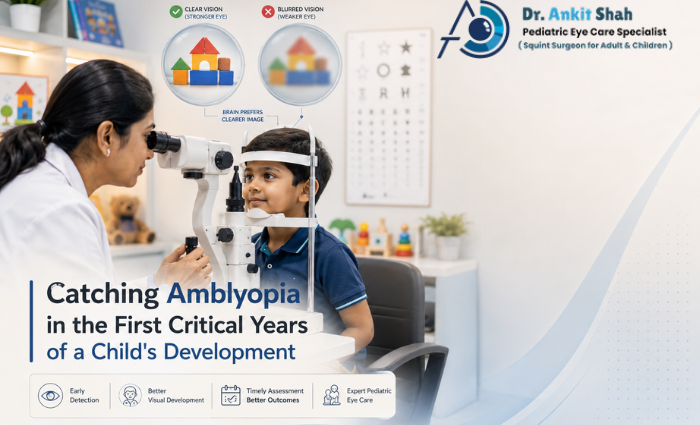
There is rapid development of the child’s vision during their early years. This is the time when the brain adapts to processing images that have been seen by both eyes, and the child gradually starts seeing things properly. However, if the brain fails to get proper images from one of the eyes, it starts depending upon the other eye for vision. This causes a problem called amblyopia.
Amblyopia in children is also termed as ‘lazy eye’, where the condition causes one or both eyes to see without achieving the proper vision levels. This happens due to the fact that there is no apparent defect in the structure that could explain the lack of proper vision.
It is particularly vital to recognize the condition during childhood, since the visual system of the child is still developing.
What Causes Amblyopia in Children?
There are several ways through which amblyopia may occur due to a less or a blurry image being received by the brain from one eye.
First of all, there is the case where there is a great variation in the spectacle powers of both eyes. In addition to that, the refractive errors, such as astigmatism, myopia, and hyperopia in either or both eyes may result into this disorder.
Strabismus, also referred to as squinting, is also another condition that may lead to amblyopia. Whereby, strabismus involves poor alignment of the eyes whereby the brain tends to ignore an image coming from one of the eyes to prevent double vision.
Another factor that may hinder proper development of vision in children is any physical obstruction of the vision such as the presence of a cataract or a droopy eyelid.
Why Are the First Years So Important?
Childhood eye development involves a period when the visual pathways between the eyes and brain are maturing. If the brain repeatedly receives a poor-quality image from one eye during this period, the connection between that eye and the visual processing areas of the brain may not develop normally.
This is why simply identifying that a child can see with both eyes is not always enough. A child may appear to function normally while one eye has significantly weaker vision.
Early assessment gives an eye specialist an opportunity to identify the underlying reason for reduced vision and determine whether intervention is appropriate.
What Signs Should Parents Look For?
Children may not complain about amblyopia because they often do not realize that their vision is different from what it should be. Parents may instead notice changes in behavior or visual habits.
Possible signs include:
- Frequently closing or covering one eye
- Tilting or turning the head while looking at something
- Squinting frequently
- Difficulty judging distances
- Eyes that appear misaligned
- Difficulty with visually demanding activities
- Poor performance in tasks requiring detailed vision
However, the absence of these signs does not rule out amblyopia in children. Some cases can only be identified through an appropriate eye examination.
How Is Amblyopia Diagnosed?
An eye examination for a child usually goes beyond determining whether the child can recognize letters or images from a distance. This eye examination can include an assessment of the acuity of both eyes, the refraction error of the child, eye alignment, and the condition of the eyes.
For very young children, appropriate methods can be employed to test their vision despite the inability to recognize letters.
Finding out the cause is one of the essential aspects of amblyopia treatment. The suitable strategy depends on a number of things, including the age of the child, visual impairment level, refractive disorder, and other eye disorders that might affect him/her.
What Does Amblyopia Treatment Involve?
Treatment is individualized according to the child’s specific condition. Correcting an underlying refractive error with spectacles may be an important first step. In some cases, additional treatment may be recommended to encourage the weaker eye to become more actively involved in vision.
This can include temporarily covering the stronger eye with an eye patch or using other methods recommended by the treating eye specialist.
The purpose of amblyopia treatment is not simply to make the weaker eye see more clearly with a spectacle prescription. It is to encourage the developing visual system to use the affected eye more effectively.
Parents should follow the treatment schedule recommended by their child’s eye specialist because consistency can be an important part of the process.
Why Regular Monitoring Matters
Amblyopia is a developmental problem, hence the monitoring does not automatically end once the condition is diagnosed. Vision changes as the child grows; therefore, adjustments have to be made based on the results of the treatment.
Follow-up helps the eye specialist to measure any improvements in vision, assess both eyes, and decide whether the ongoing therapy works or needs modification.
A pediatric eye specialist is also able to diagnose problems such as refractive errors and squint that might be the cause of low vision.
Early Attention Can Support Better Visual Development
Amblyopia in children can be difficult for parents to recognize because children often adapt to reduced vision in one eye. Early eye examinations can therefore play an important role in identifying problems before they become more difficult to address.
Dr. Ankit Shah, a pediatric eye specialist with expertise in pediatric ophthalmology and squint care, provides evaluation and guidance for children’s developing visual needs. A timely assessment can help determine whether a child has amblyopia or another condition affecting vision.
If you have noticed unusual visual behavior, eye misalignment, or concerns about your child’s vision, book an appointment with Dr. Ankit Shah for a comprehensive pediatric eye evaluation and personalized guidance