
A Clinical Look at Myopia, Hyperopia and Astigmatism and How They Differ Today
Proper vision requires that there be light entering the eye and being focused at the right point. However, where there is no proper focus by the focusing mechanism of the eye, one will have blurred and/or distorted vision. Such types of visual problems are called refractive errors and include myopia, hyperopia and astigmatism.
While all three can affect the quality of vision, they are not similar. Knowing the difference between myopia hyperopia and astigmatism will enable the parent to notice the changes in vision and understand the need for an eye examination, especially when their children are still growing.
What Is Myopia?
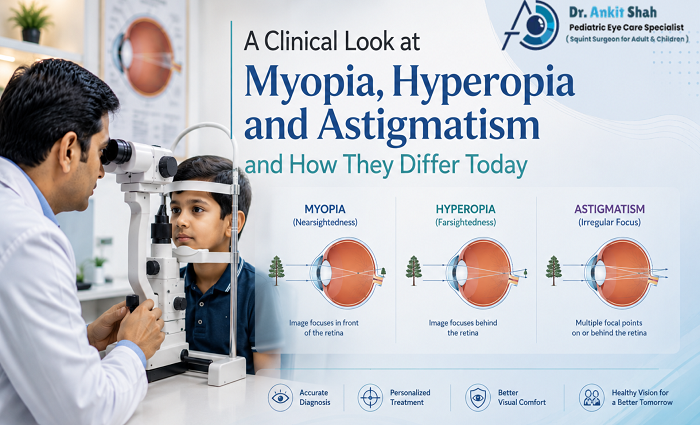
Myopia, which is also known as short-sightedness or near-sightedness, is the condition in which the eye focuses light in front of the retina instead of focusing the light directly onto it. In this case, close objects will appear clearer than distant objects.
Children suffering from myopia find it hard to read text written on the board, identify people who are far away, and enjoy being outdoors because of the inability to see clearly.
Both myopia and hyperopia are different in terms of focusing light in the eye, but they might negatively affect a child’s vision at school and other places. Myopia, however, progresses with time due to the growing eyes of the child.
What Is Hyperopia?
Hyperopia (or farsightedness) refers to the situation where the light focuses beyond the retina. This may cause distant images to be clearer compared to nearby images based on the level of hyperopia and accommodative capacity of the person.
There is compensation for some refractive error in children by the use of accommodation to help compensate for a certain degree of hyperopia. Hyperopia can result in problems such as blurring of close vision, eyestrain, headaches, or inability to maintain comfortable vision while reading.
Since there is compensation in children for some refractive errors, lack of any problems does not necessarily imply perfect vision.
What Makes Astigmatism Different?
Astigmatism is distinct from simple myopia or hyperopia in that astigmatism is normally caused by the irregular shape of the cornea or in some instances even the lens. The light rays fail to converge at a point, but the eye focuses on the light rays differently in different directions.
It leads to poor vision when looking at distant or near objects. Astigmatism in children may exhibit the symptoms of squinting, visual discomfort, or having a hard time reading small print.
Astigmatism can be accompanied by either myopia or hyperopia, which implies that a child has a refractive error of the eyes.
Myopia, Hyperopia and Astigmatism: Key Differences
| Condition | Common visual effect | Typical focusing issue |
| Myopia | Distance vision appears blurred | Light focuses in front of the retina |
| Hyperopia | Near vision may be blurred or uncomfortable | Light would focus behind the retina |
| Astigmatism | Blurred or distorted vision at different distances | Uneven focusing due to differences in curvature |
The important point is that myopia hyperopia and astigmatism can present differently, and their effects can vary depending on the child’s age and the severity of the refractive error.
Why These Conditions Matter in Children
Refractive errors are critical during childhood because visual input plays a key role in proper development of visual skills. Undetected or substantial refractive errors can impede a child’s ability to use his eyes efficiently.
Children sometimes are not aware that there is any vision issue, assuming that everyone sees in the same way, or that seeing things blurry is just okay. This means that an eye exam might be beneficial even if there are no vision problems.
A child’s eye exam may assist in assessing visual clarity, refractive problems, eye alignment, and overall eye health. Based on findings, an eye specialist may advise observation, glasses, or further examinations.
When Should Parents Consider an Eye Examination?
If a child has the tendency to squint always, is able to see only when he or she gets very close to either the screen or the book, experiences headache and eyes discomfort, and has trouble seeing the board in the class, then it is advised that an eye test should be considered.
Moreover, children who come from a family with a history of refractive disorders should be observed properly.
This kind of evaluation could be carried out by a pediatric eye specialist who considers refractive disorder in connection with the age and visual development of a child.
Understanding the Difference Helps With Better Eye Care
Myopia, hyperopia and astigmatism are important concepts to know because there can be many different reasons for poor vision. They all have different optical properties, and a child could even have more than one.
Early diagnosis helps parents get acquainted with their child’s visual requirements and make the right decisions about the correction and follow-up of such a condition. The benefit of eye checkups is especially great in those years when a child’s vision and eyes develop rapidly.
Dr. Ankit Shah, a pediatric eye specialist with expertise in pediatric ophthalmology and squint care, evaluates children’s vision with consideration for their age, visual development, and individual eye-health needs.
If your child is experiencing blurred vision, squinting, headaches, or difficulty seeing clearly, book an appointment with Dr. Ankit Shah for a comprehensive eye evaluation and appropriate guidance.