
What a Comprehensive Myopia Control Program Involves for Young Patients Today
Most parents believe that a short-sighted child just has to have a new pair of glasses every year or so. Glasses provide clear vision, but they do not necessarily stop the eye from continuing to grow longer. This is why myopia control in children has become a major part of eye care for young children, and knowing what a myopia control program entails helps families to make more informed and less stressful choices.
Why Myopia Needs More Than a Stronger Pair of Glasses
In myopia, the length of the eyeball is greater than it needs to be, leading to blurred vision of far objects. Because children’s eyes are still growing, this lengthening can take place for years to come, usually resulting in an increase in spectacle power as well. This constant change is called myopia progression, and it is possible to learn more about how it takes place in growing children and why it should be regularly monitored.
It is a myopia program, not a myopia correction program. Myopia control is simply a specific approach to the broader picture of myopia management that considers the rate of a child’s eye growth and the options to control that growth appropriately.
Step One: A Detailed Baseline Assessment
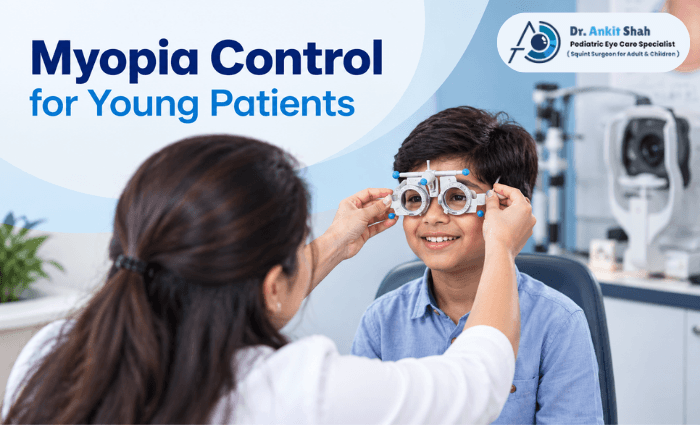
Every sound program begins with a thorough eye examination. Along with checking vision, the ophthalmologist will usually look at:
- the child’s exact refractive error, often checked after dilating drops
- how the eyes work together and focus
- the overall health of the front and back of the eye
- family history, since childhood myopia often runs in families
- the child’s daily routine, including screen use and time spent outdoors
This first visit works as a baseline. There is no other easy way to determine down the line if the myopia has stabilized or progressed without this.
Step Two: Choosing the Right Management Approach
Nothing is effective for every child. After the exam, the doctor reviews the options for myopia treatment for children that are appropriate for that individual child. These may include, based on the child’s age, prescription, and how the eyes are changing:
- specially designed spectacle lenses meant to slow progression
- prescribed medicated eye drops, used in a carefully chosen strength
- specialised contact lens options for older, suitable children
- standard glasses with close monitoring, where the myopia is mild and stable
Each option has its own benefits, limitations and suitability criteria. That is exactly why parents should not begin any treatment on their own or on the basis of something read online. The right choice comes only after a proper examination.
Step Three: Daily Practices That Support the Program
What goes on at home is as important as what takes place in the clinic. Studies have shown that being outdoors for longer periods reduces the chances of developing myopia. In this way, outdoor play becomes an excellent habit to develop. Parents can help their child by:
- making regular breaks from assignments, reading, or screen time
- making sure there is enough light while studying
- ensuring that the distance while reading is comfortable
- developing regular sleep habits
Although none of these steps can take the place of medical professionals, together they create a healthier environment for eyes.
Step Four: Regular Follow-Ups
Myopia control means that your kid will be checked multiple times so that the doctor can see how each case compares to the last one. If the readings are stable, it is possible to continue the treatment. In case there are significant changes, the doctor will know that it is time to make changes.
The reviews will give the parents an opportunity to ask questions and share their experience of the treatment.
Is a Myopia Control Program suitable for all kids?
Not exactly. Some kids experience mild myopia which doesn’t progress very fast, and other kids have a stronger family history. The kid’s current status can be determined by a pediatric ophthalmologist. The early evaluation does not mean that the kid is treated; it means that understanding the problem is crucial before trying to solve it.
Parents should think about the kid’s eyesight check-up in the following situations:
- squints or frowns to see the board or television
- sits very close to screens or holds books near the face
- complains of headaches or tired eyes after studying
- needs a stronger prescription at almost every check-up
Important Information for Parents
A Comprehensive myopia program is an evaluation, a plan selected that suits the child, healthy daily habits, and regular monitoring. These components work in conjunction. An appropriate assessment answers parents’ questions and eliminates the need to guess.
Dr. Ankit Shah is a pediatric ophthalmologist based in Ahmedabad, specializing in Squint correction and providing pediatric eye care, vision screening, refractive assessment, and myopia control and management.
If there is a need for a pediatric eye exam for your child who needs a new pair of glasses, or if you are concerned about distance vision issues, you can consult Dr. Ankit Shah to ensure proper detection and assessment.