
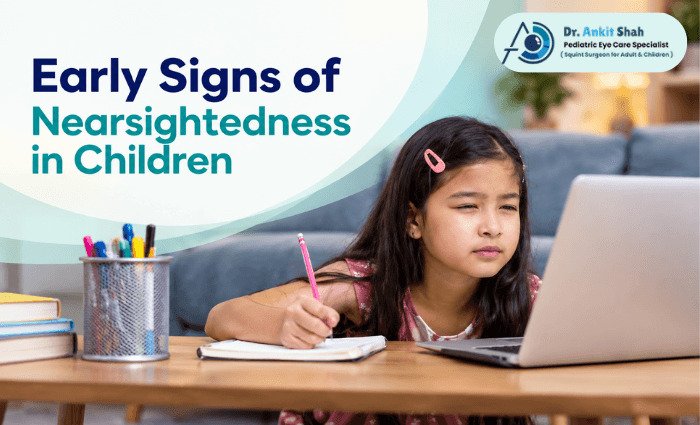

Spotting Early Signs of Nearsightedness Before It Affects a Child’s Learning
Many children cope with blurred vision for months without telling anyone. They assume everybody sees the classroom board the way they do, so they lean forward, squint a little, and carry on. By the time a parent or teacher notices, marks may have slipped, and confidence may have taken a knock. This is why recognising the early signs of nearsightedness matters so much during the school years.
What Is Nearsightedness in Children?
Nearsightedness, also called myopia, is a refractive error in which nearby objects look clear but distant ones appear blurred. It usually happens when the eyeball grows slightly longer than normal, so light focuses in front of the retina instead of on it.
In many children, nearsightedness in children begins somewhere between six and twelve years of age and can change as they grow. Since near vision stays sharp, a child may look perfectly fine while reading or using a tablet.
How Can Blurred Distance Vision Affect Learning?
Classroom learning depends heavily on seeing from a distance: the board, charts, presentations, and even the teacher’s expressions. A child who cannot see these clearly has to guess, copy from a classmate, or slowly stop trying.
This is often mistaken for inattention, laziness, or lack of interest. In reality, the cause may be blurred distance vision that has never been tested.
Which Early Signs Should Parents Watch For?
Children rarely say, “I cannot see.” Their behaviour usually gives the clue instead. Common signs include:
- Squinting or half-closing the eyes to look at distant objects
- Sitting very close to the television or holding books and phones near the face
- Frequent eye rubbing or excessive blinking
- Headaches or tired eyes, especially after school hours
- Copying notes incorrectly or complaining that the board is unclear
- Avoiding games that need distance judgement, such as cricket or football
- Tilting the head or moving forward to see better
One sign alone may not mean much. A few of them together, however, are a good reason for an eye check-up for your child.
What Classroom Changes Should Not Be Ignored?
Teachers are often the first to notice. A child who keeps asking to change seats, or who finishes board work later than classmates, may be struggling to see. A sudden dip in handwriting, reading interest or sports participation can also be a clue.
It helps to ask the class teacher for honest observations. A short conversation can save a child months of difficulty.
Why Are Regular Eye Tests Important Even Without Complaints?
Children adapt quickly, so they may not realise their vision is poor. School screenings are useful, but they are not a substitute for a detailed examination by a paediatric ophthalmologist at a child-focused practice.
A complete assessment checks vision in each eye, measures the spectacle power accurately, and reviews eye health and alignment. In children, drops that relax the focusing muscles are often used to get a reliable reading. Early detection also lets the doctor track how quickly the eyes are changing.
Are There Any Myths Parents Should Let Go Of?
A common belief is that sitting close to the television damages the eyes. Usually it is the other way round: the child sits close because distant things look blurred.
Another worry is that spectacles make the eyes weaker or “dependent”. They do not. Glasses simply let the child see clearly, which is exactly what learning requires. Delaying them out of fear only prolongs the struggle at school.
What Can Parents Do at Home?
Some daily habits support healthy visual development:
- Encourage outdoor play every day, as studies suggest it may lower the risk of developing myopia
- Take short breaks during long study or screen sessions
- Keep reading material at a comfortable distance with good lighting
- Limit recreational screen time according to the child’s age
- Do not postpone an eye test if myopia runs in the family
These habits help, but they cannot replace a professional assessment.
How Is Nearsightedness Managed?
Spectacles are usually the first step, and many children become more attentive and confident in class soon after wearing them. Because myopia can increase with growth, regular follow-ups are needed to update the prescription.
If the power is rising quickly, the doctor may discuss myopia control options to slow progression. The right myopia management plan depends on the child’s age, current power, and rate of change, so it should be decided only after a proper examination.
Helping a Child See Clearly and Learn Confidently
Noticing the early signs of nearsightedness does not need special training. It only needs a little attention to how a child behaves with things far away. The sooner the problem is found, the easier it is to protect both vision and classroom performance.
If your child squints, complains of headaches, or seems to be slipping in class for no clear reason, book an appointment with Dr. Ankit Shah for a thorough evaluation and clear guidance on the next steps.


