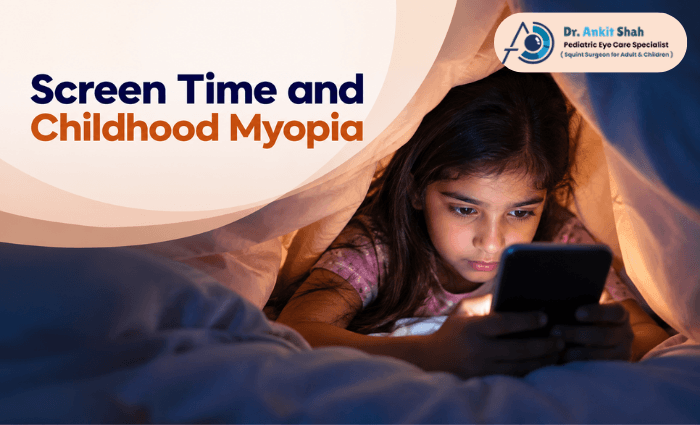

Screen Time as a Contributing Driver Behind Rising Childhood Myopia Rates
Step into almost any Indian home in the evening and the picture is familiar. A child is hunched over a phone, a tablet is balanced on the sofa arm, or a laptop is open for online homework. Over the last decade, childhood myopia has been rising steadily, and many parents quietly wonder whether screen time is the cause. The honest answer is that screens are one contributing factor among several. Knowing how they fit in helps families act sensibly rather than anxiously.
Is Myopia Really Becoming More Common in Children?
Yes, and eye specialists see it every day. Myopia in children, commonly called nearsightedness, means a child sees nearby things clearly but struggles with distant ones, such as the classroom board or a road sign. It was once fairly uncommon in primary school. Now many children need their first spectacles at six, seven or eight years of age.
Myopia occurs when the eyeball grows slightly too long, so light focuses in front of the retina instead of on it. Genes play a part, and a child with myopic parents is more likely to develop it. But genes alone cannot explain how quickly numbers are climbing, which points towards lifestyle and environment.
Where Does Screen Time Fit In?
Screens do not “burn” or directly damage a child’s eyes. The real concern is how they are used and what they replace. Phones and tablets are usually held much closer than a textbook, and children tend to stay glued to them for long stretches without looking up. This kind of sustained near work is associated with a higher risk of myopia.
The shift to online classes, and the habit of handing a phone to a restless child at mealtimes, have added hours that earlier generations simply did not have. Researchers are still untangling how much of the effect comes from screens specifically and how much from close-up activity in general, including reading and writing. Most agree that long hours of close focusing, combined with little time outdoors, create the conditions in which myopia develops more easily.
Why Outdoor Time Matters So Much
Time outdoors in daylight appears to be protective. Bright natural light seems to influence how the eye grows, and playing outside gives the eyes a long viewing distance to relax on.
The trouble is that in many Indian cities, outdoor play has been squeezed. Tuition classes, homework, heat, air pollution, and compact apartments leave little room for the park or a game of street cricket. When a screen fills the gap, a child loses twice over, with more near work and less daylight. This double shift is probably a bigger driver than screen hours alone.
Digital Eye Strain Is Not the Same as Myopia
Parents often use the two ideas interchangeably, but they are different. Digital eye strain shows up as tired or watery eyes, dryness, headaches, and occasional blurred vision after long screen sessions. It is usually temporary and eases with rest, since children blink less while staring at a screen.
Myopia, on the other hand, is a structural change in how the eye grows. It does not go away with rest, and a child can have it without feeling any discomfort at all. That is exactly why it so often goes unnoticed.
Simple Habits That Help
No family needs to ban devices completely, which is rarely realistic anyway. Small, consistent changes work better:
- Follow the 20-20-20 rule: every 20 minutes, look at something about 20 feet away for 20 seconds.
- Keep screens at arm’s length or further, and use good room lighting.
- Set clear limits on recreational screen use, especially on school days.
- Encourage at least an hour or two of outdoor play every day.
- Take regular breaks during reading and homework, not just during screen use.
These habits cannot guarantee that a child will never develop myopia, but they reduce unnecessary strain on growing eyes. Consistency matters more than perfection.
When Should a Child’s Eyes Be Checked?
Don’t wait for your child to complain. Look for signs such as sitting close to the television, squinting at the chalkboard, rubbing their eyes frequently, tilting their head, or frequently developing headaches after studying. Diminishing interest in school may also be an indication that your child may have vision problems.
Once myopia is diagnosed, it is likely to change over time and require monitoring. The progression of myopia and other important information can be found here.
Dr. Ankit Shah, who works as a paediatric ophthalmologist, can measure and track the progression of myopia and suggest ways to control it, not only providing correction of blurred vision.
Many parents worry that their child’s need for glasses may create a dependency on this procedure. However, wearing proper, prescribed lenses does not constitute worsening of myopia.
Keeping a Balance
Screens are part of modern childhood and are not going away. The aim is balance: shorter close-up sessions, more daylight, and regular eye check-ups so that changes are caught early.
If your child has been squinting, complaining of headaches, or you simply want guidance on healthy screen habits, contact Dr. Ankit Shah for a comprehensive eye evaluation and personalised advice on the next steps.