
How Uncorrected Refractive Error Affects Everyday Vision and Daily Comfort
It is very important in regards to the activities of reading, studying, working, navigating and engaging with the environment. Refractive errors are due to poor focusing of light through the eye on the retina and without treatment, what might seem like a minor visual problem can affect daily vision.
Uncorrected refractive error doesn’t automatically lead to having continuous or intense symptoms. People who suffer from this issue either get used to blurred vision, or have problems with certain tasks. It’s especially significant to identify these issues among children because vision clarity is also crucial for proper visual development.
What Is a Refractive Error?
Refractive error refers to any situation where the form of the eye and its ability to focus light rays fails to bring them into sharp focus on the retina. Myopia, hyperopia, and astigmatism are examples of refractive errors.
Whereas myopia makes distant objects appear blurry, hyperopia has its impact on near vision and is especially evident in cases of a large refractive error. Astigmatism leads to blurry vision in various distances.
The impact of uncorrected refractive error on someone depends on its type, the extent of the condition, which eye(s) is/are involved, and the person’s visual needs.
How Can Uncorrected Refractive Error Affect Everyday Activities?
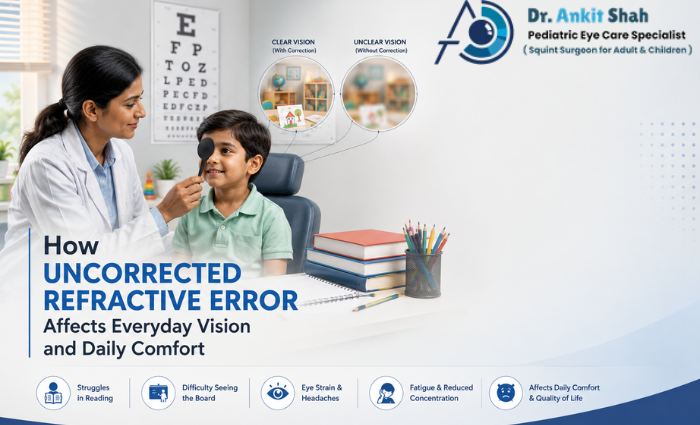
Some of the most visible consequences include difficulty perceiving details properly. Children who have uncorrected myopia will find it hard to perceive letters written on the blackboard, identify people from afar, or perform any outdoor activity due to unclear vision.
In the case of children having hyperopia or astigmatism, they may find it difficult to read, write, draw, and do other activities where they need to concentrate.
In the case of adults, uncorrected refractive errors will cause problems such as when working with the computer, reading documents, or driving.
This is because many individuals do not understand that they have refractive errors; therefore, they either move close to objects, squint, or use only one eye instead of both.
Eye Strain and Visual Discomfort
Vision involves the need for constant focusing and coordination of the eyes, especially when performing certain actions like reading, studying, or use of electronic gadgets.
Where there is improper correction of the refractive error, some people could experience eye strain, eye fatigue, headaches, or difficulty sustaining comfortable vision while performing visual actions.
There could be various reasons for such conditions, and thus they cannot be automatically assumed to be a result of refractive error. But it provides a good reason for having an eye examination done.
This is more applicable to children, especially when the complains arise during learning or studying activities.
Why Refractive Error in Children Deserves Attention
Refractive error in children should be particularly taken into consideration due to the fact that children can simply not understand that their vision differs from that of other people. A child whose vision becomes gradually impaired can consider it to be a natural condition.
In contrast to the phrase ‘I cannot see properly’, he/she may sit closer to the TV screen, get closer to the book, squint, etc.
In addition, an uncorrected refractive problem can become worse if there is a major disparity between the two eyes in terms of the refractive power of each eye. During the development years, a difference in the level of visual stimuli can prevent the proper development of vision in the weaker eye, leading to amblyopia.
This is just one reason why eye exams are valuable.
When Should Parents Consider an Eye Examination?
Parents should consider an eye examination if a child frequently squints, complains of headaches, closes one eye while looking at something, sits unusually close to screens or books, struggles to see the classroom board, or shows a noticeable change in visual behavior.
A family history of significant refractive errors may also be a reason to pay closer attention to a child’s vision.
An eye examination can determine whether the child has myopia, hyperopia, astigmatism, or another condition affecting vision. It can also help identify whether the eyes are working together appropriately.
Correcting Refractive Error Can Improve Visual Function
However, the correction that will be needed is dependent upon the individual’s age, visual needs, refractive error, and general condition of the eye.
It is important to understand that it is not just about getting a better number on the vision chart. Getting an appropriate correction will assist in seeing comfortably while engaging in various tasks as well as visual development in children.
The assessment of the refractive error and visual development in the context of the pediatric eye can be performed by a pediatric eye specialist.
Don’t Ignore Persistent Changes in Vision
An uncorrected refractive error can sometimes be easy to overlook because people adapt to gradual changes in their vision. However, persistent blurred vision, eye strain, headaches, or difficulty with everyday visual tasks should not simply be accepted as normal.
For children especially, early assessment can help identify refractive errors before they interfere with learning, visual development, or daily activities.
Dr. Ankit Shah is a pediatric eye specialist with expertise in pediatric ophthalmology and squint care, providing comprehensive assessment of children’s vision and developing eye health.
If you or your child is experiencing persistent blurred vision, visual discomfort, or difficulty with everyday activities, book an appointment with Dr. Ankit Shah for a comprehensive eye evaluation and personalized guidance.