
Mapping Out the Right Path for a Child Diagnosed With Squint Today
When a child has been identified to suffer from squint, which is also known as strabismus, there are a number of issues that arise. Does squint require immediate intervention? Are glasses sufficient? Does it require surgery? Can it impact vision development? No two children will follow the same pathway for the strabismus treatment.
The Strabismus treatment is based on the nature and level of the misalignment of the eyes, age of the patient, vision in the eyes and if there is any other visual problem in existence.
Why Does a Child Develop a Squint?
Squint is a condition where there is misalignment of both eyes. It could either occur early in life or develop at a later stage in childhood.
There are various causes of squint in childhood. Some of these include disparity in the refractive power of the eyes, issues with eye movements, and problems with normal development of vision. In some children, squint develops along with amblyopia.
Because the underlying cause can vary, the first step in strabismus treatment is understanding why the eyes are not working together normally.
What Happens During the Initial Assessment?
The pediatric ophthalmologist is able to examine the vision and eye position in relation to age-appropriate methods. The examination will involve testing of vision in each eye, testing of refraction, movement of the eyes, and determining the direction and magnitude of the deviation.
This examination is necessary since the child may seem to have good vision when in actuality only one eye provides sub-optimal vision.
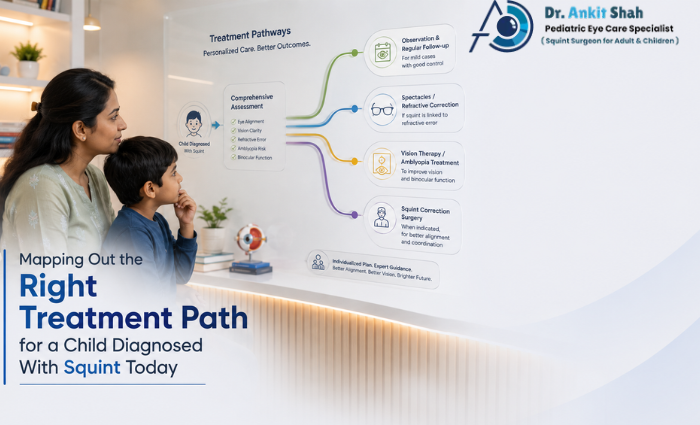
The results from the examination are vital in determining the course of action in terms of monitoring, optical correction, vision improvement, or strabismus treatment.
Can Glasses Be Part of the Treatment?
Spectacles may form an integral component of squint therapy when there is any major refractive error which is contributing towards the squint condition of the patient. Wearing the prescribed lenses will help to ensure that there is correct functioning of the eyes.
It is not true that spectacles would serve the purpose in all cases of squint and the child’s reaction to spectacles and any changes in the alignment of the eyes could provide some clues about further management.
This is why it becomes necessary to monitor the treatment.
What If the Child Also Has a Lazy Eye?
A squint and amblyopia are associated but distinct problems. In cases where a squint is observed in a child, the child is likely to have decreased vision in one eye since the brain will depend more on the stronger eye.
In such a situation, lazy eye treatment for children can be very important in the whole treatment process. The methods of treatment will vary from one child to another and include treatment of refractive problems and techniques meant to get the weaker eye involved in vision.
This is why treatment of reduced vision can be an important part of strabismus treatment.
When Is Squint Correction Surgery Considered?
All children that have been diagnosed with squint do not require an operation. But then, squint correction surgery may need to be conducted if there is misalignment of the eyes after proper treatment without an operation or in cases where an operation is clinically necessary from the beginning.
In most cases, this treatment entails manipulating eye muscles to align the eyes. It depends on various things like the nature and extent of the deviation, how the vision of the child has developed, previous treatments, and results of examination.
A squint correction specialist is able to judge all these and advise whether surgery is necessary or other methods should be used.
Why Follow-Up Is an Important Part of Treatment
Visual changes in children occur as the eyes grow, and therefore, treatment will not always stop after the first prescription has been made.
Through periodic follow-ups, the eye doctor is able to evaluate the vision in each eye, eye alignment, the progress in treatment of the condition, and make any necessary changes.
A pediatric eye care specialist can also monitor other issues that affect the visual development of the child, like refraction and amblyopia.
Choosing a Treatment Path Based on the Child
The right approach to strabismus treatment should be based on the individual child rather than simply the appearance of the squint. Some children may benefit from spectacles and monitoring, while others may require additional treatment for reduced vision or surgical correction.
Dr. Ankit Shah has expertise in pediatric ophthalmology and squint care, with a focus on assessing children’s eye alignment and visual development before recommending an appropriate treatment approach.
If your child has recently been diagnosed with a squint or you have noticed changes in their eye alignment, book an appointment with Dr. Ankit Shah for a comprehensive evaluation and personalized guidance on the next steps.