
How Parents Can Learn to Spot the Early Warning Signs of a Child’s Squint
The eyes of a child develop continuously within the early years and coordination of the eyes helps in visual development. Squint, which is referred to as strabismus, is defined as misalignment of both eyes and they may not necessarily point in the same direction.
This could be very evident to the parents especially if the eyes are not aligning well; rather, they are turning inwards, outwards, upwards or downwards. In other cases, it could be invisible. It will help the parents know what signs to look out for if anything suspicious arises.
What Does a Child’s Squint Look Like?
One of the first and most common signs of squinting eyes is if the eyes seem to be pointing in different directions. Nevertheless, this can only become apparent if the child is sleepy, sick, focused on something, or viewing objects from a certain distance.
Parents can also notice that the child’s eye appears to wander now and then or the eyes do not move in unison.
Sometimes, the problem can be adjusted for by changing the posture of the child’s head or squinting one of the eyes when the object is being observed. These symptoms are not enough to prove squinting, but they can be used as grounds for eye examination.
Watch for Changes in Visual Behaviour
A child may not inform his/her parents of any problem with his/her eyesight. The child may just get used to his/her eyesight.
Some behaviors worth noticing include:
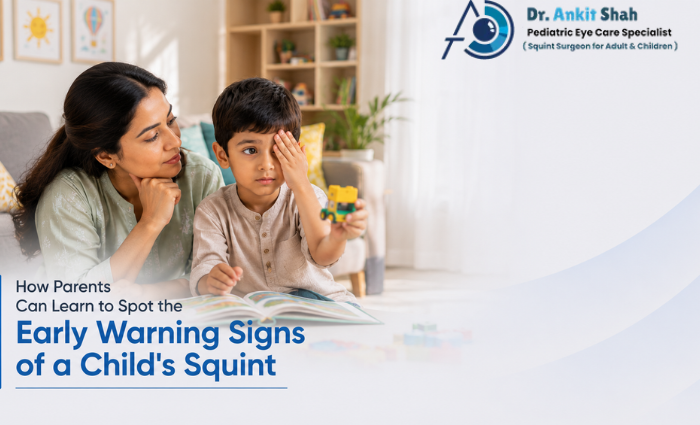
- Frequent closing or covering up one eye
- Turning or tilting the head while looking at things
- Frequent squinting
- Getting too close to books and TV screens
- Poor eyesight of things far away
- Problems with performing tasks which require good eyesight
- Complaining of headaches
These signs can have several possible causes. Refractive errors in children, for example, can also lead to squinting, difficulty seeing clearly, or changes in visual behavior.
Why Early Assessment Matters
The visual system of the child continues to develop in the early years. If one eye is sending an unclear picture, or both eyes do not function properly, the brain will start using only one eye.
In some children, this can contribute to amblyopia, commonly called lazy eye. When reduced vision is identified, lazy eye treatment for children may form part of the overall management plan.
That’s why it’s unwise for the parents to focus solely on how the eyes look. The child may have fairly normal-looking eyes but have some kind of visual disorder beneath the surface.
When Should Parents See an Eye Specialist?
A visit to an eye doctor will help establish the reasons behind any noticeable eye deviation, abnormal head posture, and other factors that may be troubling the child’s vision.
A pediatric ophthalmologist can assess the child’s vision in each eye, check eye alignment and movements, evaluate refractive errors, and examine overall eye health using techniques appropriate for the child’s age.
Consultation with a pediatric eye specialist would enable one to identify the causes of the eye deviation, awkwardness of head position, and other related causes that could be contributing to the problem.
Can Refractive Errors Be Related to Squint?
Refractive errors in certain children might also be linked to alignment issues of their eyes. Myopia, hyperopia, and astigmatism may impair the quality of the image being received by the brain.
It may also be necessary to give special attention to large differences in prescription in both eyes in childhood due to uneven visual input.
For this reason, identifying refractive errors in children can be an important part of evaluating a child who appears to have a squint or shows unusual visual behavior.
Does Every Child With a Squint Need Surgery?
Not necessarily. The mode of refractive errors treatment in child will depend on the kind of strabismus and its severity, the child’s vision, the presence of amblyopia, and other results of the eye examination.
Some children may need glasses or follow-ups, while others may need corrective treatments for their poor eyesight. In some instances, strabismus surgery may be recommended.
A squint correction specialist can assess the individual condition and explain whether observation, optical correction, treatment for amblyopia, or surgery is appropriate.
What Parents Should Remember
It is best for the parents to notice anything unusual about their children’s eyes early on. The occasional drifting of the eye does not necessarily mean that the child has strabismus, but it should not just be ignored either.
A squint specialist can determine whether the child’s eyes are aligned correctly and whether there is an associated problem affecting visual development.
Dr. Ankit Shah has expertise in pediatric ophthalmology and squint care, with a focus on assessing children’s eye alignment, vision, and developing visual needs. A timely examination can help parents understand whether a child’s visual behavior is within the expected range or requires further attention.
In case you’ve observed any unusual visual behaviors in your child such as drifting of one of the eyes, excessive blinking, head tilt, etc., then set up an appointment with Dr. Ankit Shah for a thorough eye examination.