
Weighing the Available Correction Options for Squint Eye Treatment in Adults Today
Eye squinting, known clinically as strabismus, is not only common among children; it can happen to adults as well. It can either be due to the persistence of eye squint from childhood to adulthood, or the onset of the squint could happen at any later stage in one’s lifetime. The effects of squint eye in an adult vary, depending on the type and underlying causes of the squint.
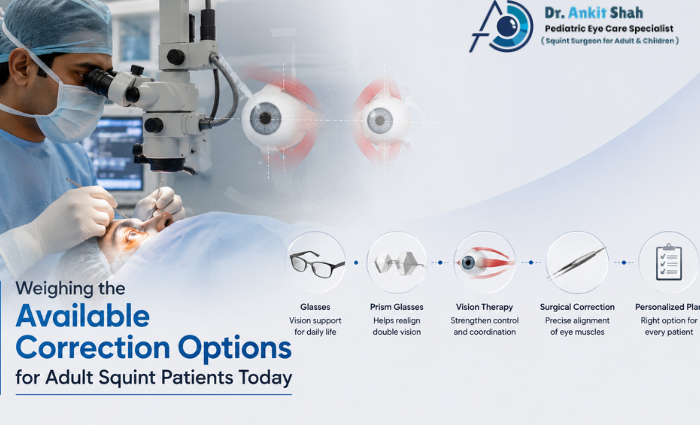
The current options for squint eye treatment in adults range from one type to another. Based on the severity and the needs of the individual, treatment for this condition can be determined.
What Can Cause Squint in Adults?
There are many different reasons why adults may have strabismus. For some individuals, their condition of squint was already present since childhood, whereas other people acquire squinting eyes during adulthood.
There are factors like vision problems, particular eye disorders, injury, past eye surgery, or issues with the nerve and muscle controlling the eye movements that might contribute to the development of squint among adults.
For those adults who acquire squinting eyes, especially if there is diplopia, an eye examination would be needed. It is essential to identify the cause of squint to determine the best strabismus treatment.
Can Glasses Help?
Use of spectacles may be helpful in some conditions of squint eye treatment in adults. If the person suffers from any kind of refractive error, then using glasses may help make the image seen by the eyes more clear and may enhance coordination among both eyes.
But it is to be kept in mind that glasses may not be able to correct all types of misalignment of eyes. It will depend upon the refractive error present, the degree of deviation, and cooperation of both eyes.
Thus, an eye check-up becomes important before deciding whether glasses are enough or something else is needed.
What Is the Role of Prism Glasses?
The use of prisms can be considered in case of squint in adulthood if double vision is present. Prisms change the course of the incoming rays of light, thus helping the eyes see more accurately aligned images.
Prisms can be of great assistance to some patients, but they cannot be applied to all types or degrees of squinting. The magnitude and stability of eye displacement and patient symptoms are taken into account while considering this treatment method.
For some adults, prism correction can therefore form part of a broader approach to squint eye treatment in adults.
When Is Squint Surgery Considered?
Squint eye surgery for adults may be considered when a significant eye deviation remains and surgical correction is appropriate. Strabismus surgery involves adjusting selected eye muscles to improve the alignment of the eyes.
The decision to undergo squint correction surgery is individualized. Factors such as the direction and degree of the deviation, previous eye treatments or surgeries, double vision, binocular vision, and the patient’s treatment goals may all be relevant.
Importantly, squint eye correction surgery for adults is not necessarily performed only for cosmetic reasons. Depending on the individual, improving eye alignment may also address functional concerns associated with misalignment.
Is Adult Squint Only a Cosmetic Concern?
The presence of a squint will clearly have some effect on an adult’s confidence and appearance, but there could be effects which are not related to how their eyes appear.
Adults could suffer from double vision, eye strain, difficulty with binocular vision, and depth perception. Some could have a squint that they have lived with all their lives and adapted to with few problems.
Therefore, the goals of squint eye treatment in adults can vary. For one person, improving alignment may primarily address double vision or visual function, while another may place greater importance on improving eye appearance.
Why Is Individual Assessment Important?
Individuals who appear to have identical eye deviations may actually have different causes for their eye conditions. An individual may have an established squint since childhood while the other might have acquired his eye deviation due to some other ocular or neurological issue.
Comprehensive examination includes the evaluation of the following:
- Vision
- Refractive error
- Eye position at different distances
- Eye movements
- Eye coordination
A strabismus specialist can use these findings to determine whether observation, spectacles, prism correction, treatment of an underlying condition, or squint eye surgery for adults should be considered.
Choosing the Right Approach
There is no single treatment that is appropriate for every adult with strabismus. Squint eye treatment in adults may involve optical correction, prism glasses, management of an underlying condition, or squint correction surgery, depending on the clinical findings.
Dr. Ankit Shah has expertise in strabismus treatment, including adult and pediatric squint evaluation and surgical management. His approach focuses on understanding the individual’s eye alignment, symptoms, and visual requirements before discussing suitable treatment options.
If you have a long-standing squint, newly developed eye misalignment, or persistent double vision, book an appointment with Dr. Ankit Shah for a detailed evaluation and personalized guidance regarding your correction options.
For children especially, early assessment can help identify refractive errors before they interfere with learning, visual development, or daily activities.
Dr. Ankit Shah is a pediatric eye specialist with expertise in pediatric ophthalmology and squint care, providing comprehensive assessment of children’s vision and developing eye health.